The Ground That Does Not Shift
When Truth Feels Uncertain
We live in a time when truth is often treated as something flexible—something personal or changeable depending on perspective. People often say, “My truth is different than your truth,” or “Truth changes over time.” In this way of thinking, truth becomes soft, shifting, and uncertain.
But Scripture presents a very different picture. Truth is not an opinion or a trend. Truth is something we discover because it already exists in God.
Jesus: The Truth Made Visible
In John 14:6, Jesus says, “I am the way and the truth and the life. No one comes to the Father except through me.” Jesus does not say He teaches the truth. He says He is the truth. Truth is not just a concept. It is a person.
To know Christ is to know the truth. To walk with Him is to walk in truth. To depart from Him is to move into confusion and distortion.
What Scripture Says About Truth
“You will know the truth, and the truth will set you free.” —John 8:32
“Sanctify them by the truth; your word is truth.” —John 17:17
“All your words are true; all your righteous laws are eternal.” —Psalm 119:160
“The unfolding of your words gives light.” —Psalm 119:130
“Let God be true, and every human being a liar.” —Romans 3:4
Scripture presents truth as steady, reliable, and rooted in God Himself.
When We Live Outside of Truth
When our thinking moves away from truth, life often becomes more chaotic and painful. Many emotional struggles are connected to distorted or untrue beliefs:
“I will never get better.”
“No one cares about me.”
“I am a burden.”
“Everything is ruined.”
“God has abandoned me.”
These thoughts may feel real, but feelings are not the same as truth. When we believe things that are not true, we begin to live as though they are true, and that creates suffering.
Truth does not always remove pain, but it prevents pain from turning into confusion and despair.
An Exercise: Filtering Your Thoughts Through Truth
Step 1: Write the Thought
Write down a troubling thought you have been having.
Step 2: Ask Three Questions
1. Is this thought fully true?
2. What does Scripture say about this?
3. What is a truer statement I can hold onto?
Example:
Thought: “God has forgotten me.”
Truth: “Never will I leave you; never will I forsake you.” —Hebrews 13:5
Instead of: “I am a burden.”
Try: “I am struggling right now, but God says I am valuable and loved.”
The goal is not forced positivity. The goal is bringing your thoughts back under the guidance of truth.
Truth as a Foundation
Truth anchors us when emotions are unstable. It corrects distorted thinking, brings clarity to confusion, and provides direction when we feel lost.
Without truth, the mind becomes like a city without walls—open to every fear, every lie, and every passing thought. With truth, there is structure, clarity, and stability.
Bringing It All Together
Truth is not something we create. Truth is something we return to.
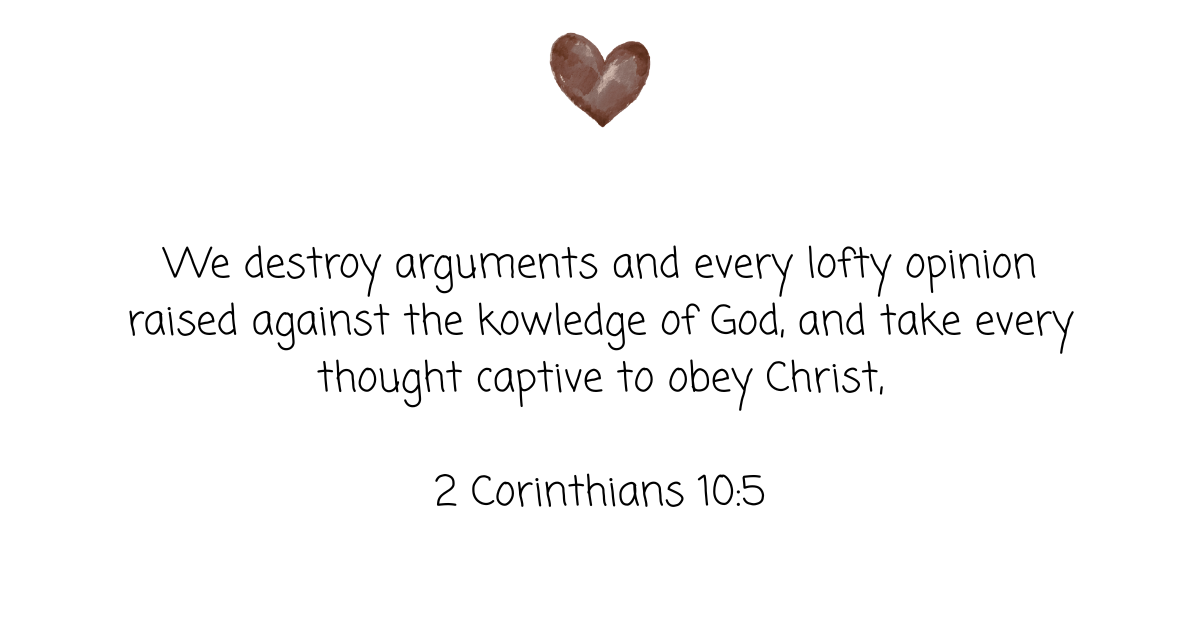
Jesus is the truth. God’s Word is truth. And truth leads us toward freedom.
When our thoughts drift away from truth, life becomes more painful and confusing. But when we return to what is true—again and again—we begin to find steadiness.
Truth becomes the ground beneath our feet. A foundation that does not shift with every emotion or circumstance.
Not perfect lives. But lives that are built on something solid. Lives guided by truth.
COMMON THINKING DISTORTIONS
Recognizing the thought patterns that can work against us
Thinking distortions, also called cognitive distortions, are habitual patterns of thinking that can lead us to interpret situations inaccurately or draw conclusions that are not fully supported by the facts. They often happen automatically, and we may not recognize them at first.
Everyone has distorted thoughts from time to time. Having one does not mean something is wrong with us. The goal is to notice the pattern, examine the evidence, and consider a more balanced way of understanding the situation.
All-or-Nothing Thinking (Black-and-White Thinking)
What it is: Seeing things in extremes, with no room for a middle ground.
What it can look like:
“If I can't do this perfectly, I've failed.”
“We had one disagreement, so this relationship is a disaster.”
“I missed one day of my routine. I've ruined all my progress.”
Overgeneralization
What it is: Taking one negative experience and assuming it will always happen.
What it can look like:
“I didn't get that job. I'll never find work.”
“That friendship ended badly. I can't trust anyone.”
“I struggled today, so I'm always going to struggle.”
Mental Filtering
What it is: Focusing almost entirely on the negative details while overlooking the positive or neutral ones.
What it can look like:
Receiving several compliments and one criticism, then thinking only about the criticism.
Having a mostly good day but replaying one awkward conversation.
Completing most of a task but seeing only what remains unfinished.
Discounting the Positive
What it is: Dismissing positive experiences or accomplishments as unimportant, accidental, or undeserved.
What it can look like:
“They only said that to be nice.”
“It wasn't really an accomplishment. Anyone could do it.”
“I was lucky. It doesn't count.”
Jumping to Conclusions
What it is: Deciding what something means without enough evidence. Two common forms are mind reading and fortune telling.
What it can look like:
Mind reading: “She didn't reply because she's angry with me.”
Fortune telling: “I know this is going to go badly.”
“They looked at me strangely, so they must think I'm foolish.”
Catastrophizing
What it is: Expecting the worst possible outcome or treating a problem as if it will become a disaster.
What it can look like:
“If I make a mistake at work, I'll lose my job and everything will fall apart.”
“This symptom must mean something terrible is happening.”
“If this conversation goes badly, our relationship will be over.”
Emotional Reasoning
What it is: Treating feelings as proof that a belief or conclusion is true.
What it can look like:
“I feel guilty, so I must have done something wrong.”
“I feel anxious, so this situation must be dangerous.”
“I feel unlovable, so nobody could really care about me.”
Should Statements
What it is: Using rigid rules about what we or other people should, must, or ought to do.
What it can look like:
“I should be able to handle everything myself.”
“My family should know what I need without my having to ask.”
“I must never make mistakes.”
Labeling
What it is: Defining ourselves or another person by a single behavior, mistake, or characteristic.
What it can look like:
“I made a mistake. I'm an idiot.”
“He forgot to call. He's a terrible person.”
“I struggled with that assignment. I'm a failure.”
Personalization
What it is: Taking responsibility for something that is not entirely within our control, or assuming another person's behavior is about us.
What it can look like:
“My friend seems quiet. I must have upset her.”
“My child is having a difficult day. I must be a bad parent.”
“The meeting went poorly, so it must be my fault.”
Blaming
What it is: Assigning all responsibility for a problem to another person or circumstance, without considering the full picture or our own choices.
What it can look like:
“Nothing can improve because everyone else is the problem.”
“I only reacted that way because you made me.”
“My circumstances determine every choice I make.”
Magnification and Minimization
What it is: Making problems or mistakes seem much larger than they are while making strengths, successes, or positive qualities seem smaller.
What it can look like:
“That small mistake was absolutely disastrous.”
“My accomplishment was nothing.”
“Everyone noticed my one awkward comment, and nobody noticed anything good.”
Comparing
What it is: Measuring our worth, progress, or circumstances against someone else's, often without knowing the full story.
What it can look like:
“Everyone else has their life together except me.”
“She's more successful, so my work isn't worthwhile.”
“I should be where that person is by now.”
Control Fallacies
What it is: Believing we have either complete control over everything that happens or no control over anything that happens.
What it can look like:
External control: “There's nothing I can do. My life is entirely determined by other people.”
Internal control: “It's my job to make sure everyone around me is happy.”
“If I plan carefully enough, nothing bad will ever happen.”
Fallacy of Fairness
What it is: Assuming that life or other people must follow our personal definition of fairness, and feeling that something is wrong simply because it is not fair.
What it can look like:
“After everything I've done, this shouldn't be happening to me.”
“If I treat people well, they should always treat me well.”
“It's unfair that I have to work harder than someone else.”
Always Being Right
What it is: Treating being right as more important than understanding another person's perspective or considering new information.
What it can look like:
“I don't need to hear their side. I already know I'm right.”
“Changing my mind would mean I lost.”
“If someone disagrees with me, they must be wrong.”
How to Challenge a Distorted Thought
The purpose is not to force ourselves to think positively or ignore real problems. It is to slow down, look at the evidence, and develop a more accurate and balanced thought.
Notice the thought. What exactly am I telling myself?
Name the pattern. Does this sound like catastrophizing, mind reading, all-or-nothing thinking, or another distortion?
Check the evidence. What facts support this thought? What facts do not support it?
Consider another explanation. Is there another reasonable way to understand what happened?
Create a balanced thought. What could I say that is realistic, fair, and based on what I actually know?
What evidence supports or challenges that thought?
________________________________________________________________________
________________________________________________________________________
What is a more balanced way to think about the situation?
________________________________________________________________________
________________________________________________________________________
Remember: A thought is not automatically a fact. Learning to recognize thinking patterns gives us an opportunity to pause, examine what we are telling ourselves, and choose a more balanced response. These skills can be practiced independently or with support from a qualified mental health professional.